
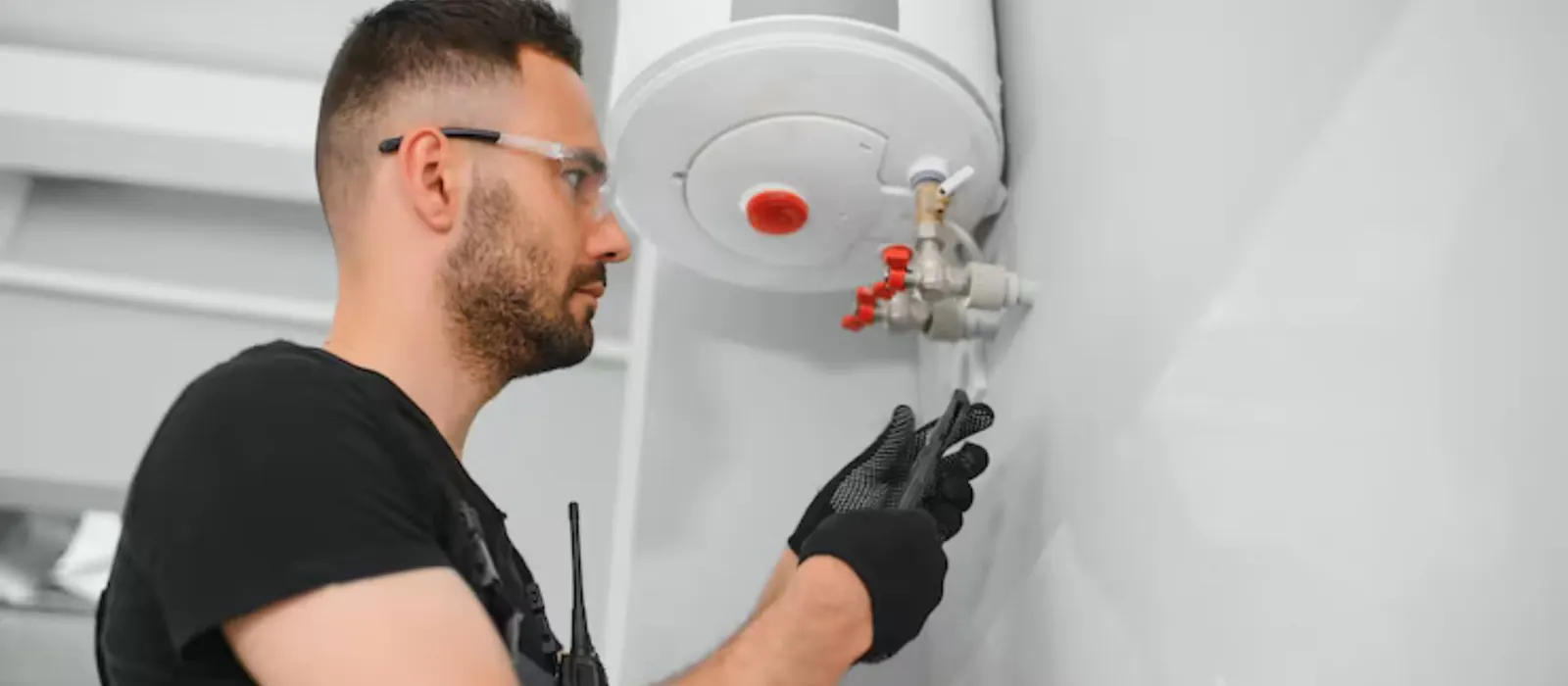
If an electric water heater has gone lukewarm or cold, a failed heating element is the most common cause. Most tanks have two elements, an upper and a lower, and each can be tested with a meter and replaced in under an hour by a trained plumber. A tank that is leaking from its body is a different problem and needs replacement.
How an electric water heater heats
An electric tank holds 30 to 80 gallons of water and heats it with two screw-in elements that sit behind small access panels. The upper element heats the top of the tank first. Then the thermostat hands over to the lower element, which keeps the rest warm.
That is why the symptom tells you which part failed. If you run out of hot water quickly, the lower element is often burned out. If the water is lukewarm, the upper element or a thermostat may be the cause. If there is no hot water at all, check the breaker, the reset button and the upper thermostat before blaming an element.
Symptoms that point to an element
Typical signs
- Hot water runs out fastThe lower element has failed, so only the top third of the tank heats.
- Water is lukewarmThe upper element has failed or a thermostat is set wrong.
- Breaker trips repeatedlyA shorted element can leak current to the tank.
- Popping or rumblingScale on the elements is trapping water against hot metal.
- No hot water at allBoth elements, a thermostat or the high-limit reset may have failed.
Safety first: power off and tested
Electric heaters run at 240 volts, and the elements are wired directly to the power. Turn the breaker off, then confirm with a tester that the wires are dead before touching anything. Never work on a heater with the power on.
The tank must also be drained below the element before it is unscrewed, or hot water will pour out. That is the step that scalds people. If you are unsure, a plumber does it in minutes and has the tools.
Testing an element with a meter
- Switch off the breaker and verify the wires are dead.
- Remove the access panel and insulation, then disconnect the wires from the element.
- Set a multimeter to resistance and touch the probes to the element terminals. A working element reads a low number, often between 10 and 25 ohms.
- An open circuit or no reading means the element has failed.
- Touch one probe to a terminal and the other to the tank. Any reading means the element is shorted to ground.
Compare the reading with the rating on the element's label. A reading far off the expected value, or none, means it needs replacement.
Replacing an element
- 1
Drain below the element
Close the cold supply, attach a hose to the drain valve and drain until the water level is below the element.
- 2
Remove the old element
Unscrew it with an element wrench and check the threads and gasket seat.
- 3
Install the new element
Match the wattage and voltage, thread it in and tighten with a new gasket.
- 4
Refill before power
Open a hot tap, refill the tank completely and only then restore the power.
The last step is the one that matters most. Energizing an element in an empty tank burns it out in seconds. A new element that dies right away often means the tank was not full.
Should you replace the tank instead?
| Situation | Verdict |
|---|---|
| Tank under 10 years, no leaks, bad element | Replace the element |
| Tank 10 to 12 years, second repair in a year | Plan a replacement |
| Tank leaks from the body | Replace the tank |
| Heavily scaled tank, rusty water | Replace the tank |
An element is cheap compared with a tank, so it is worth fixing when the tank is sound. The water heater repair page explains how we diagnose the rest, and a leaking tank is a replacement call.
Preventing the next failure
- Flush the tank yearly to remove sediment
- Check the anode rod every few years
- Keep the thermostat at a moderate setting
- Replace both elements if one is badly scaled
- Install a water test before buying a replacement if scale is heavy
Mistakes that turn a cheap fix into a costly one
The most common error is working on an element with the power still on. Turn off the breaker, then confirm with a non-contact tester that the wires are dead. Many electric water heaters have two breakers or a double-pole breaker, and a heater that seems off can still be live at the upper element.
The second error is energizing the heater before the tank is full. A dry element burns out in seconds. Open a hot tap, wait until water runs steadily with no sputtering, and only then restore power.
- Skipping the gasket, which causes a slow leak at the element flange
- Over-tightening the element and cracking the threads in the tank
- Buying the wrong wattage or the wrong style of element
- Ignoring a rusty tank, where the element is not the real problem
- Forgetting to reset the high-limit button after a trip
Frequently asked questions
Lukewarm water suggests the upper element or a thermostat. Running out of hot water quickly suggests the lower element.
It is possible for someone comfortable with electrical safety, but the tank must be drained and the power proven off. Many owners call a plumber.
The most common cause is switching the power on before the tank was full. Another is a shorted thermostat.
Element replacement is usually done by a plumber. If the wiring or breaker is the problem, an electrician may be needed.
The state treats replacing a working part as more than a minor repair. Ask the Hingham building department about your case.