
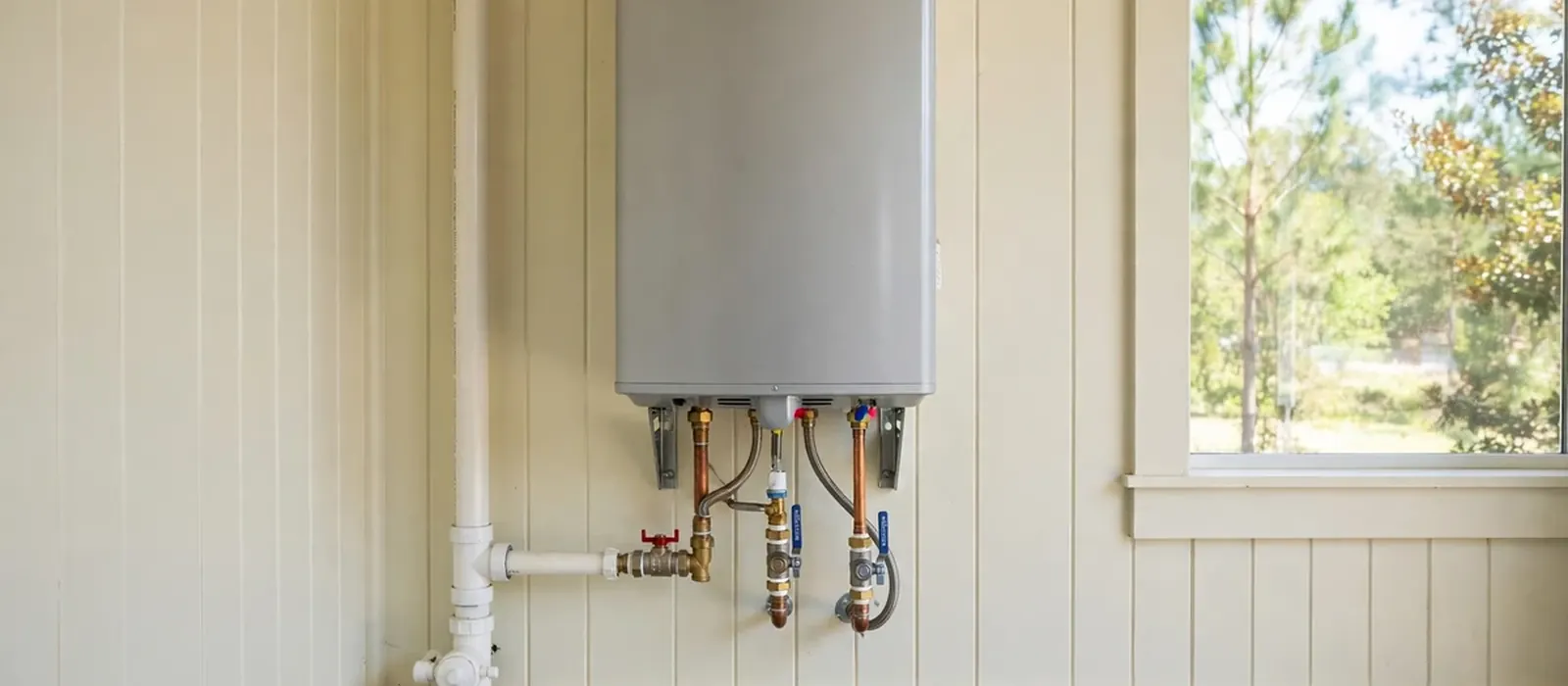
A tankless water heater installation in Hingham needs three things beyond the unit itself: a gas line large enough for the burner, a vent route to the outside and a plan for condensate and scale. If your house can supply all three, a tankless unit gives continuous hot water in a fraction of the floor space.
How tankless units work
When you open a hot tap, flow through the unit triggers a burner, and a heat exchanger warms the water as it passes. There is no stored tank, so the unit does not run out as long as the flow stays within its rating. A typical whole-house gas unit is rated in gallons per minute at a given temperature rise.
In New England the incoming water is cold in winter, so the temperature rise is large, and the flow a unit can deliver drops. A unit that is fine in July can struggle with two showers in January. That is why sizing uses the coldest water, not the average.
What your house needs
| Requirement | Why it matters | Common fix |
|---|---|---|
| Gas line capacity | The burner fires at a high rate | Upgrade the pipe, sometimes the meter |
| Venting | Exhaust must go outside through sealed vent | Stainless or PVC run to a wall or roof |
| Electrical | Controls and fan need power | A nearby outlet or circuit |
| Condensate drain | High-efficiency units produce acidic condensate | Drain or neutralizer |
| Water quality | Scale reduces flow | Flush valves, softening or filters |
Many older houses fail the first test. A gas line that fed a 40-gallon tank may not carry enough fuel for a whole-house tankless unit, and a gas fitter has to size the pipe from the meter to the heater. Massachusetts requires a licensed plumber or gas fitter for that work.
Sizing for winter
- List the fixtures that run at the same time, such as two showers and a dishwasher
- Add the flow rates in gallons per minute
- Pick a unit whose rating at a winter temperature rise covers that flow
- Leave a margin for the longest pipe run
- Consider two smaller units if the house is large
A unit that is too small gives hot-then-cold swings, and one that is too large costs more than it needs to. A plumber who asks about your showers and your coldest day is doing it right.
Maintenance you cannot skip
Tankless heaters need a yearly flush. Minerals form scale on the heat exchanger, which cuts flow and efficiency and can trigger error codes. The flush is a loop of vinegar or a manufacturer-approved solution circulated for about an hour.
If you skip it, the first sign is often an error code for flow or ignition. Many tankless repair calls we see are descaling jobs in disguise. A set of isolation valves installed at the beginning makes the yearly flush much easier.
Costs and trade-offs
Tankless costs more than a tank to buy and install, and the savings come from lower standby loss and longer life. The numbers depend on how much hot water you use and what you pay for fuel. For a small household that uses little hot water, the savings are modest, and a tank may be the better value.
| Question | Tank | Tankless |
|---|---|---|
| Up-front cost | Lower | Higher |
| Running out of hot water | Possible | Not within the flow rating |
| Floor space | Large | Small |
| Yearly upkeep | Flush and anode | Descale |
| Install complexity | Lower | Higher |
The water heater installation page covers tank options if tankless is not the right fit. If your current heater has failed, an emergency replacement may come first and the upgrade second.
Questions to settle before you order
A tankless unit makes hot water on demand, but it is not a drop-in swap. It needs enough gas flow or electrical capacity to heat water quickly, and it needs a vent path that meets the manufacturer's rules. Those two items decide whether a project is simple or involves new gas pipe, a new vent and a new electrical circuit.
- How many fixtures will run at once at your busiest hour
- Whether the existing gas line is large enough for the burner
- Where the vent will exit the house
- Where the condensate drain will go
- Whether you want isolation valves for yearly flushing
- Whether a recirculation pump would suit your layout
Plan for water quality too. Scale builds up inside a tankless heat exchanger, and a yearly flush keeps it clean. Installing service valves at the start makes that flush a simple task later.
Ask the plumber to walk you through the unit once it is installed. You should know where the shutoff valves are, how to read the display and how to start a flush. Keep the manual and the warranty papers with the service dates written on them.
Frequently asked questions
It can be if you have high hot water demand or tight space and the gas line and vent can be upgraded. For a small household the savings are modest.
Hingham's posted rule bars water piping on outside walls, with no exceptions. Keep the unit and its water lines inside the heated space.
Yearly is the usual recommendation, and more often with hard water.
Often yes. The burner fires at a higher rate than a tank heater's.
Yes. The posted fee schedule lists a plumbing and a gas permit for a domestic water heater, with rough and final inspections.