
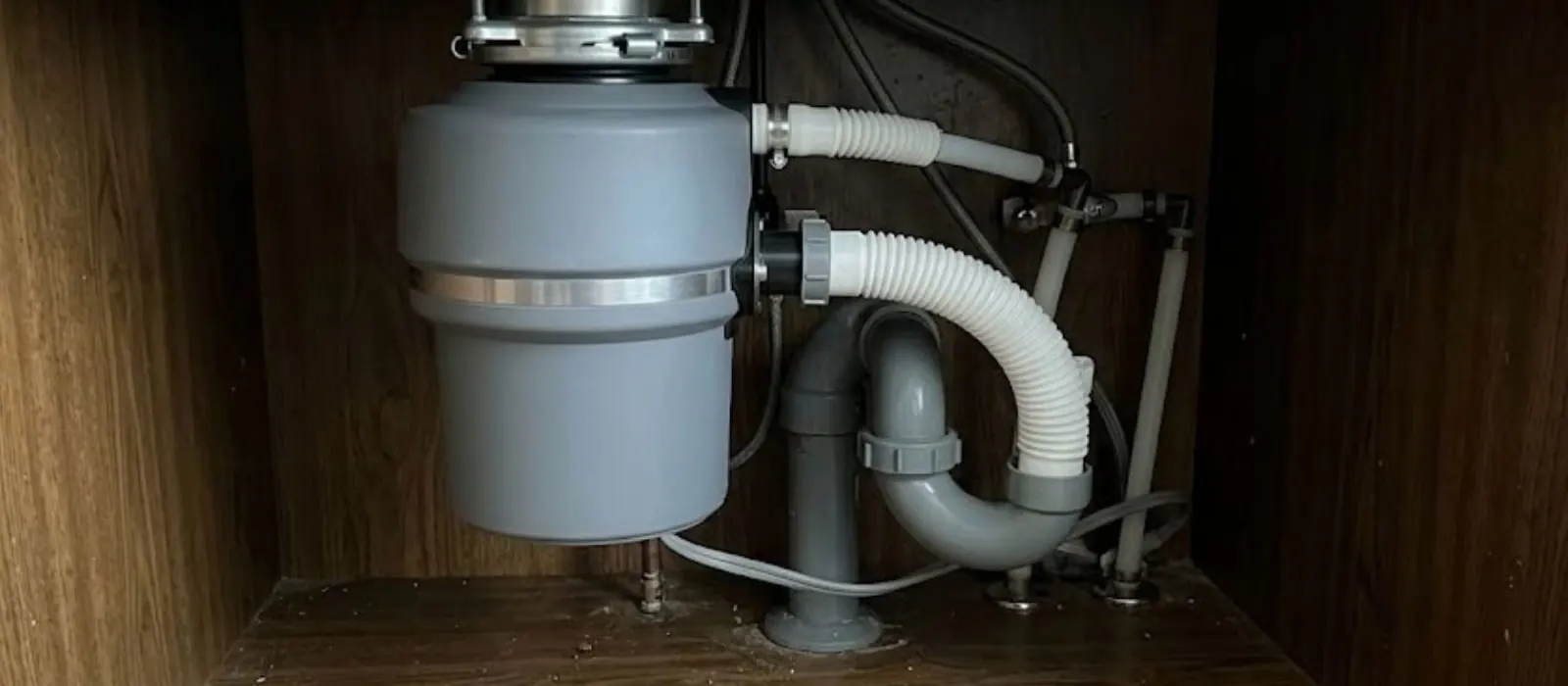
Replacing a garbage disposal takes about an hour for a handy homeowner when the old unit is the same type and the wiring and drains are in good shape. It means disconnecting the old unit, mounting the new one under the sink flange and reconnecting the drain and power. If the house has no disposal, a new installation adds a power source and a switch.
Before you buy
- Check whether your sink has a standard three-bolt mounting flange
- Note the horsepower of the old unit and how much you cook
- Check for an outlet under the sink or a hardwired connection
- Look for a dishwasher drain connection that must be reconnected
- Confirm you are on town sewer and not on septic
Horsepower matters less than people think, but a larger motor jams less and runs more quietly. A quarter or a third horsepower is fine for a small household, while a half horsepower or more suits heavy use.
What you will need
| Item | Why |
|---|---|
| Screwdriver and pliers | Remove the old mounting ring and clamps |
| Plumber's putty | Seals the sink flange |
| Disposal kit with gasket and mounting hardware | Included with most units |
| Power cord kit or wire nuts | Connects the unit to power |
| Bucket and towels | Catch water from the trap |
| Hammer and a flat tool | Knock out the dishwasher drain plug |
Step by step
- 1
Power off and disconnect
Switch off the breaker, unplug or disconnect the old unit and remove the drain trap and dishwasher hose.
- 2
Remove the old unit
Loosen the mounting ring, lower the unit and remove the old flange if it is worn.
- 3
Mount the new unit
Apply putty to the new flange, set the mounting ring and tighten the three screws evenly.
- 4
Reconnect drains and power
Connect the dishwasher inlet, the drain elbow and the power cable, then test for leaks.
If you have a dishwasher, knock out the plug inside the dishwasher inlet on the new unit, or the dishwasher will not drain. It is the most common mistake on a new disposal and the first thing a plumber checks.
Electrical: cord or hardwire
Most disposals connect to an outlet under the sink or to a switch on the wall. A cord kit makes the connection simple, but a hardwired connection must be done correctly with the power off. If the wiring looks old or there is no switch, an electrician may be needed.
Common mistakes
- Over-tightening the flange, which cracks the sink
- Leaving out the putty or the gasket, which causes slow leaks
- Forgetting the dishwasher knockout
- Using flexible, ribbed drain pipe that traps food
- Running the disposal with no water
Using a disposal wisely
Run cold water while the unit runs and for fifteen seconds after. Feed it small amounts of food waste, and keep out grease, bones, fibrous vegetables such as celery and potato peels. A disposal does not remove grease from the pipe. It sends it down the line, where it cools and sticks.
If your sink backs up, the clog may be in the drain beyond the unit. See drain cleaning. If the unit hums, jams or leaks after install, see garbage disposal repair.
When to call a plumber
Call when the drain connections are corroded, the cabinet floor is soft from leaks, the wiring is unsafe or the sink needs new plumbing. A first-time installation that adds a switch and an outlet also benefits from a licensed plumber and electrician.
Before you buy a disposal
Check the space under the sink first. A disposal with a larger motor is taller and heavier, and a cabinet with a trap or a filter on the same side may not have room. Measure from the sink flange down to the shelf or the pipe and compare that number with the product's dimensions.
Then think about the load. A quarter or third horsepower unit handles light scraps for a small household. A half or three-quarter horsepower unit grinds harder waste and runs more quietly. Continuous-feed models start with a wall switch, while batch-feed models start only when the stopper is turned.
Electrical and plumbing connections
- A disposal needs a nearby outlet or a hard-wired connection with a switch
- The dishwasher drain connects to a knockout on the disposal that must be opened first
- The discharge pipe must slope down toward the trap with no sag
- A sink with two bowls needs a different trap layout from a single bowl
- A leak at the flange usually means the plumber's putty was skipped
Remove the knockout plug for the dishwasher line before you mount the unit. Forgetting it is the most common reason a new dishwasher backs up into a new disposal.
Frequently asked questions
About an hour for a like-for-like swap, longer if wiring or drains need work.
Ask the Hingham building department. The state treats replacing working parts as more than minor, and the town posts per-fixture fees.
Heavy use adds solids to a septic tank. Ask your septic professional or your Board of Health before relying on one.
The knockout plug in the disposal's dishwasher inlet was probably left in place.
Often yes when the unit is in stock, and same-day appointments when available.