
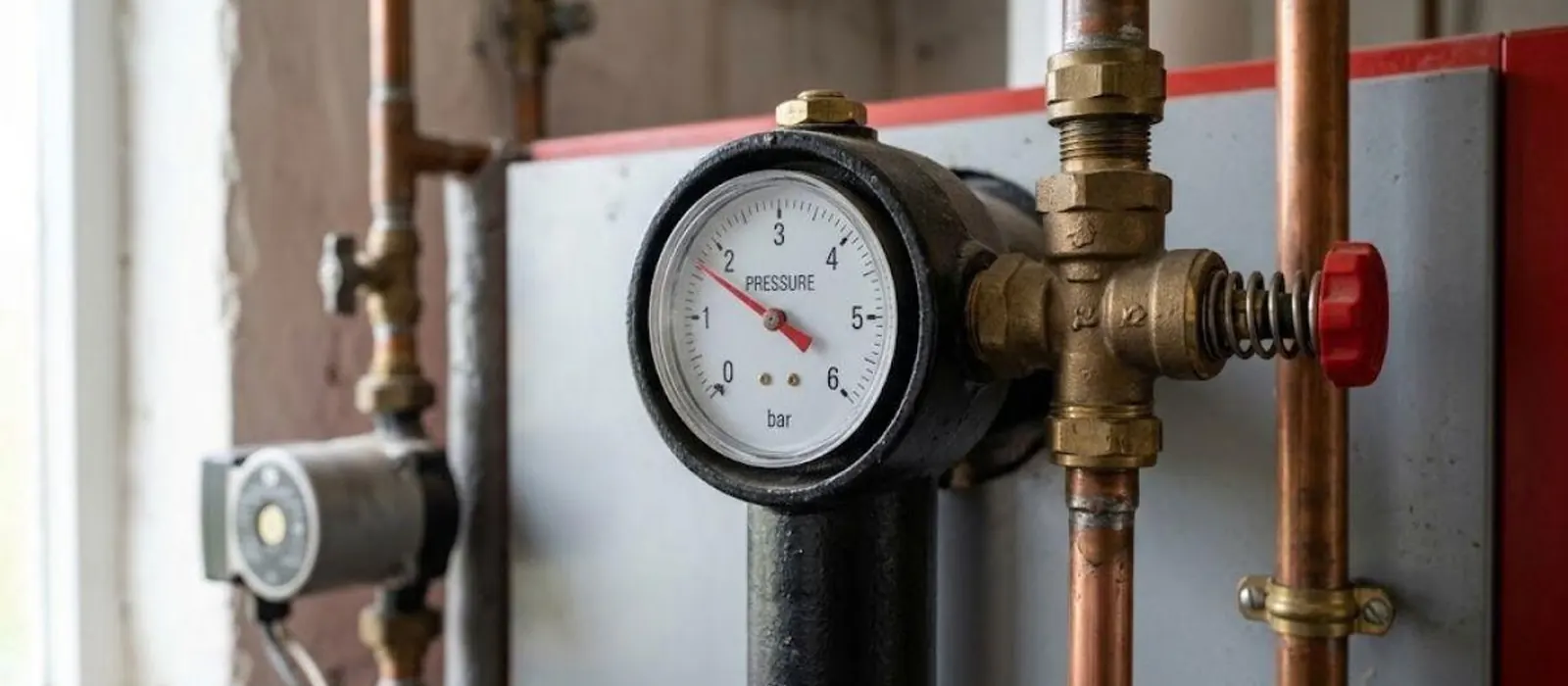
A boiler that is leaking water usually has a failed fitting, a weeping valve or a pressure problem, and only sometimes a failed heat exchanger. Switch the boiler off, close the water feed to it and find where the water is coming from. A drip from a fitting is often a quick repair, while a leak from the boiler's body usually means replacement.
First steps when a boiler leaks
- Turn the boiler's power switch off.
- Close the water feed valve to the boiler if there is one.
- Place a bucket under the drip and wipe the area dry.
- Look closely for the source, from the top down.
- If you smell gas or see rust and scorch marks, leave and call the gas utility or 911 from outside.
Do not keep topping off a leaking boiler. Fresh water adds oxygen and minerals, which speeds up corrosion inside the system.
Where leaks usually come from
| Source | Look for | Usual outcome |
|---|---|---|
| Relief valve | Drip at the discharge pipe, often after the system heats | Check pressure and the expansion tank first |
| Circulator flange | Weeping at the pump flange | New gaskets or a new pump |
| Pipe fitting or valve | Mineral crust or rust at a joint | Replace the fitting or valve |
| Fill valve | Constant refilling, pressure too high | Replace the valve |
| Expansion tank | Water in the air side | Replace the tank |
| Boiler body | Water seeping from the casing or base | Usually replacement |
A relief valve that drips is often reacting to high pressure, not failing on its own. An expansion tank that has lost its air charge cannot absorb the water's expansion, so the pressure climbs until the valve opens. Replacing the valve without fixing the tank only treats the symptom.
Pressure: the number to check
Most residential hydronic boilers run at about 12 to 15 psi when cold and rise as the water heats. A gauge that climbs toward 30 psi means the relief valve is about to open. A gauge that falls to zero means water is leaking out somewhere.
If the pressure keeps dropping, you have a leak in the system, even if you cannot see it. A hidden leak in a wall or under a slab calls for leak detection, and the repair may be a plumbing job.
What a plumber fixes and what needs a burner technician
A plumber handles the water side of the system. That includes valves, circulators, expansion tanks, fill valves, air eliminators and leaking pipe. The burner, the controls that fire it and the combustion system may need a licensed oil or gas technician.
Our boiler repair page describes what we handle and when we refer. A plumber who says so honestly saves you a second visit.
Repair or replace the boiler
- Age 25 years or more with a leaking body: replace
- A leaking heat exchanger: replace
- Repeated pump or valve failures in a young boiler: repair
- Rust and scale throughout the system: consider flushing, and replacement if heavy
- Parts no longer available: replace
If you are planning a replacement, ask for a heat loss calculation. Many older houses have boilers sized for a drafty house that has since been insulated, and a smaller boiler may run more efficiently.
Where a boiler leak usually starts
Most boiler leaks begin at a joint, a valve packing or a circulator flange, not in the boiler body. A slow drip at one of those points can often be fixed without replacing the boiler. A leak from the boiler's seams, or from the base with rust streaks, is a different story because it usually means the heat exchanger or a section has failed.
The relief valve is a special case. A relief valve that drips can be a worn valve, but it can also be opening because system pressure is too high or because the expansion tank has lost its air charge. Replacing the valve without checking the pressure leads to a second drip a week later.
What to do before the plumber arrives
- Turn off the boiler at its service switch.
- Close the water feed valve to the boiler if you can reach it.
- Place a bucket under the drip and note how fast it fills.
- Photograph the pressure gauge and the leak location.
- Keep a window or door clear so the plumber can reach the unit.
If you smell gas or oil, leave the house and call the gas company or 911 first. Plumbers repair the water side of a boiler. A burner problem needs a licensed oil or gas technician.
Keep a short log while you wait. Write down when you first saw the water, how the pressure gauge reads when the system is cold and when it is hot, and whether the leak gets worse when the heat runs. A plumber can often name the likely part from that log before touching a tool.
Frequently asked questions
It can be. A steady leak, a loss of heat in winter or any gas smell is urgent. Switch the boiler off and call.
High pressure from a failed expansion tank or a bad fill valve is a common cause.
A small top-off through the fill valve is normal, but repeated refilling means there is a leak to find.
Plumbing work requires a licensed plumber under state law. Burner work may need a licensed oil or gas technician.
Use the state's eLIPSE portal and ask to see the permit if one is required.